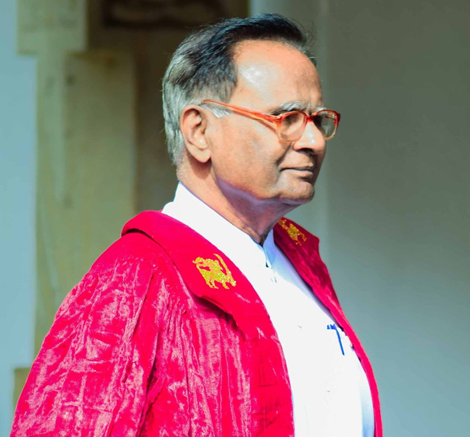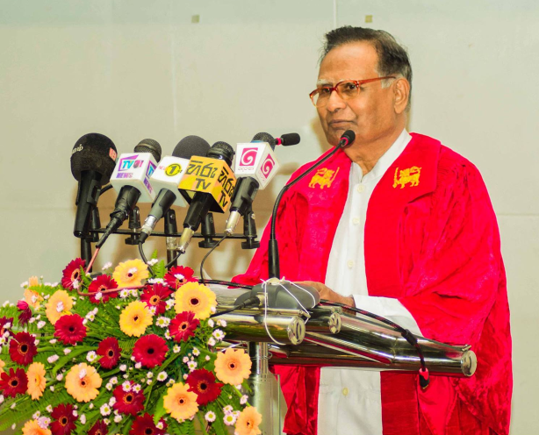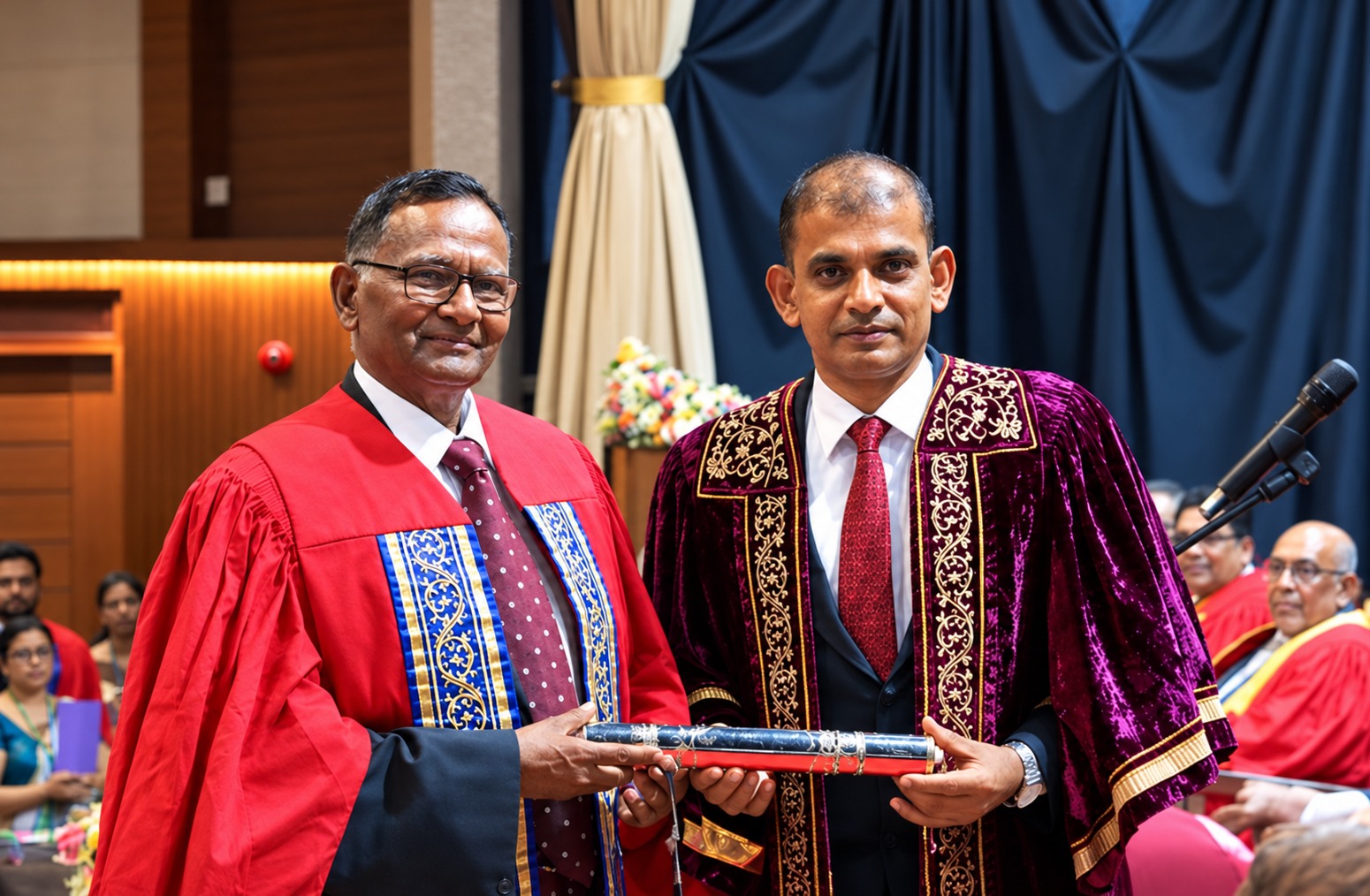
Rajarata University of Sri Lanka at its recent General Convocation, conferred the Degree of Doctor of Literature (D. Litt. Honoris Causa), on Emeritus Professor C. M. Madduma Bandara, in recognition of his distinguished contributions to higher education, research and national development, together with his initial role in advancing the concept of a regional University. This rare honour acknowledges a scholar whose work connected academic inquiry with national policy making and whose close association with the University since its inception dating back to over three decades.
An Early Advocate for a Rajarata University
Professor Madduma Bandara’s acceptance of this honour recounts his involvement in deliberations that helped in shaping the idea of a university serving the Rajarata Region. It was in the early 1980s, when the accelerated Mahaweli Development Project was under way, he had the opportunity of participating in a discussion at the Kalawewa Rest House with the Minister in-charge of the subject and some of his other advisors. Their thoughts focused on the emerging needs of nearly a million people expected to settle in the new development areas and the opportunities that would open for them and their next generation.
In these discussions Professor Madduma Bandara drew attention to the limited provision of university education across five provinces in the central region, where Peradeniya was the only university at that time, serving a wider national and international community. Following his intervention, he was requested to prepare a concept note for the Ministry on this subject. He submitted a related memorandum on 18 February 1984, providing an early written contribution to the proposal for a university in Rajarata Region.
As he recalled, progress on this proposal was initially slow, and lukewarm and it encountered some discouragement, primarily due to concerns about the colossal capital required. He subsequently joined an informal group of scholars and officials from the region who were committed to the cause and supported by the leadership of the Speaker of Parliament. Their sustained advocacy, alongside the efforts of local political leadership, helped in advancing the pace of establishment of the University.
In the years that followed his initial effort the group expanded its scope in preparing a more comprehensive concept paper that included proposed founding of faculties and the process to be followed in establishing the university itself. Prof Madduma Bandara also attended the ceremonial opening of the University as an invited Vice Chancellor representing Peradeniya, witnessing the realization of an initiative he had helped to nurture. In his acceptance of the Honorary Degree, he also expressed his desire to deposit his original memorandum and the full concept paper developed by the group subsequently, in the University archives. These documents may help in preserving an important but less well known, episode of Rajarata University’s institutional history.
Academic progress and leadership in Higher Education
Educated at Central College, Anuradhapura, and the University of Peradeniya, Professor Madduma Bandara obtained his PhD from the University of Cambridge in 1972, specializing in land–water interactions (Hydo-Geomorphology). He began his academic career at the University of Colombo in the mid-1960s and subsequently served at Peradeniya, where he became Head of the Department of Geography and later promoted to the rank of Professor on merit. He served as Vice-Chancellor of the University of Peradeniya from 1994 to 1997, navigating a period of turbulence and turmoil.
His academic journey spans over four decades and includes appointments and scholarly work at the universities in Ilorin Nigeria, Cambridge UK, Tokyo, Tsukuba and Kyoto in Japan, as well as the United Nations University in addition to that of his home universities. He also had the opportunity of working with international organizations such as the World Bank, USAID, NORAD, GTZ and the International Union for Conservation of Nature. This experience further enriched his contributions to university teaching, research, administration and international academic collaboration.
Research Addressing National Needs
Professor Madduma Bandara’s research contributions encompassed interdisciplinary fields including environmental management, land policy, water resources, watershed management, coastal planning, agro-well development and traditional knowledge systems. He has more than 100 research papers and publications to his credit in peer-reviewd journals, with over 1,000 Google scholar citations. In his acceptance of the D. Litt, he claimed that more than 75 per cent of his publications were single-authored and that his citations records continued to increase even after retirement in 2004 demonstrating a lasting impact.
Among his principal contributions were the development of the concept of village tank cascade systems in 1985. It highlights the recognition of cascade systems by the Food and Agriculture Organization’s Globally Important Agricultural Heritage Systems (GIAHS) Framework. His work also contributed to the development and promotion of agro-wells, drawing on lessons from South India to explore groundwater use for agriculture in Sri Lanka. Other significant contributions include mapping the Island’s entire coastline in the early 1980s, contributing to the development of coast conservation legislation, providing leadership in formulating the first National Environmental Action Plan (NEAP). He is also well known for proposing the re-demarcation of Sri Lanka’s colonially inherited Provinces based on natural river basin boundaries. His work on indigenous knowledge and biodiversity was published by Kyoto University in 2008. Traversing differing fields of inquiry, his research demonstrates a sustained concern with applying academic knowledge to practical questions of development and resource management.
His public responsibilities have included serving as Chairman of the Presidential Land Commission 1985 to 1989, Chairman of the National Water Resources Authority in 2004, Chairman of the Academic Board of the National Institute of Education, and Chairman of the National Environmental Council.
A Record of Rare Service Deserving Recognition
Professor Madduma Bandara’s contributions have previously been recognised through an award of Honorary Doctor of Science from Sabaragamuwa University in 2010 followed by an Honorary Doctor of Letters from the University of Peradeniya in 2023. He has received an Award of Merit from Lanka Jalani, the national counterpart of the Global Water Partnership, for his service to the water sector. Further accolades include Rajarata Abhimanaya in 2020, Hela Abhimanya, awarded by indigenous medical professionals in 2025, and an Award of Excellence from the Bhikkhu University of Sri Lanka in 2026. He is a Fellow of the National Academy of Sciences, Sri Lanka, and the Royal Geographical Society of London.
His scholarly achievements, long university leadership and contributions to national policy making provide a strong foundation for the honorary degree awarded. For Rajarata University, this recognition has particular significance: it honours a scholar who helped initial conceptualizing of the University, and contributed to its early planning and remained committed to the educational aspirations associated with its establishment.
In accepting the degree, Professor Madduma Bandara acted as a role model to Rajarata students through his academic journey from the distant Konewewa to Cambridge, UK, while encouraging all graduates to use their qualifications for both personal advancement as well as for the welfare of the nation. He rare demonstrated intellectual prowess, moral integrity and a lifelong commitment to the development of the Country.